Animals as Objects
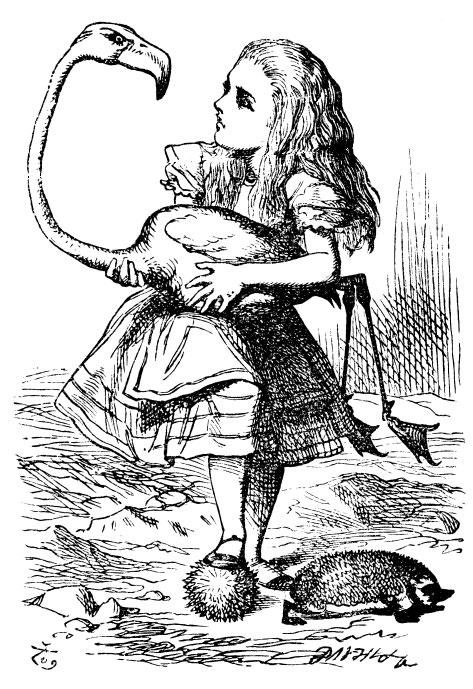
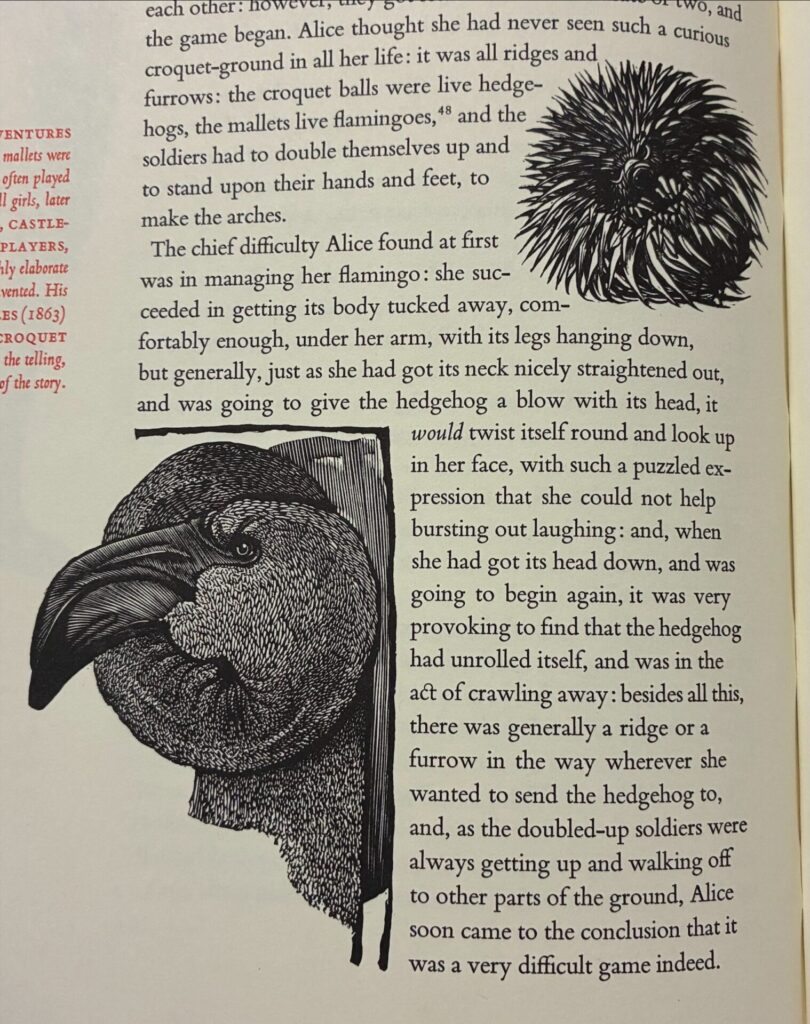
“Alice thought she had never seen such a curious croquet-ground in her life: it was all ridges and furrows: the croquet balls were live hedgehogs, and the mallets live flamingos, and the soldiers had to double themselves up and stand on their hands and feet, to make arches.”
In Alice’s Adventures and Looking Glass, dynamics between animals and objects blend together to comment on categorization and what it means to be alive. This dynamic is perfectly summed up in Alice’s description of the croquet-ground. The animals are used as sports equipment for the human occupants. They are silent spectators to their own abuse. Tenniel’s illustration of the scene focuses on Alice handling the animals and prepping to play croquet with the Queen. But in Moser’s illustration, Alice is not present and he focuses on the individual animals.
Animals as Objects
But, in places outside of the Queen of Heart’s garden, the animals have agency. They outnumber the humans significantly, are able to talk, and participate equally in various endeavors. The Queen of Heart’s weeds out that type of behavior to strip them of their resolve and make them subservient to her. Her gardens are a microcosm that reveals the repercussions of the abuse of power on social hierarchy and make the reader question the treatment of animals in the real world.
Wonderland’s Darwinism
“What I was going to say,” said the Dodo in an offended tone, “was, that the best thing to get us dry would be a Caucus-race.”
“What is a Caucus-race?” said Alice; not that she much wanted to know, but the Dodo paused as if it thought that somebody ought to speak, and no one seemed inclined to say anything.”
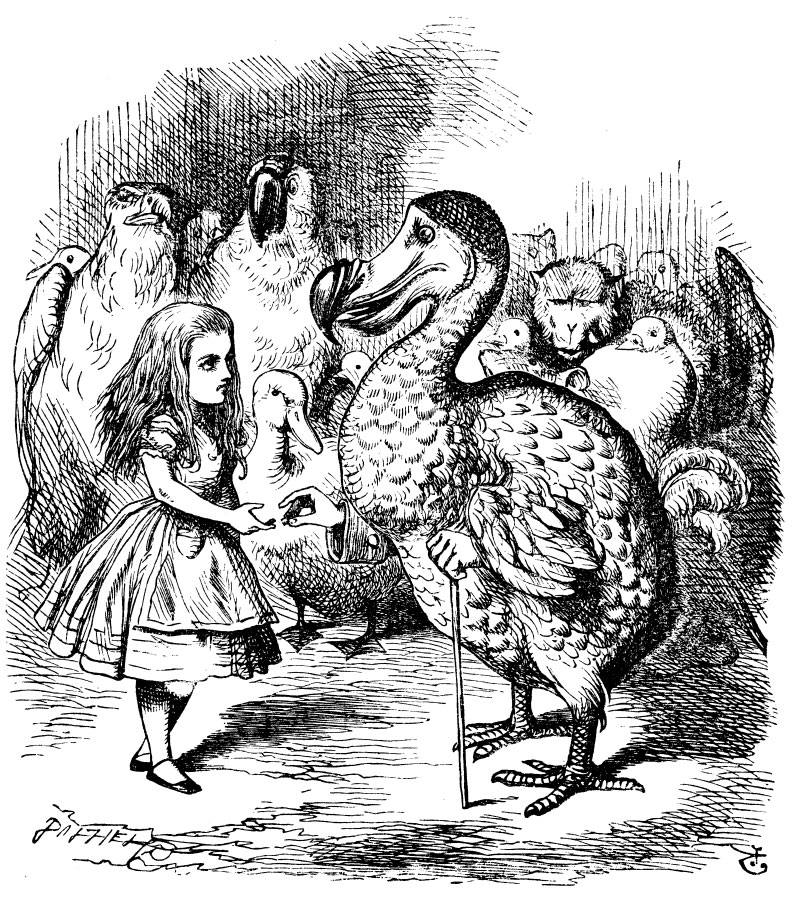
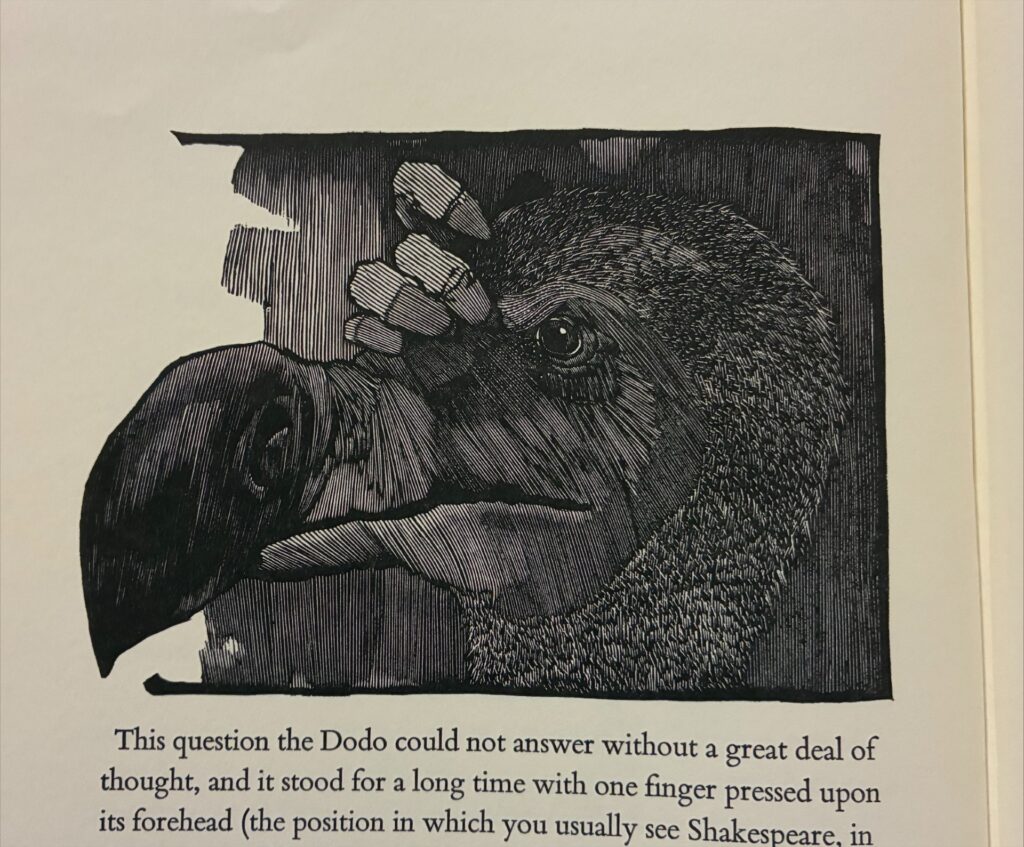
The nonsense of Wonderland’s environment breeds an equally nonsensical social hierarchy. The members of Carroll’s society have many different types of living things, including extinct animals. Many have debated on Carroll’s views of Darwinism. Scholars have come to the general consensus that Carroll believed that there were many holes in Darwinism, but thought that his work was well done and deserving of attention. The fact that everyone won the race poses the question, “what does survival of the fittest truly mean?” and “what factors determine who is the fittest?” The Dodo bird, who became extinct in the 17th century, is used for the same purpose. Tenniel’s drawing depicts Alice talking to the Dodo about the results of the race. Moser’s illustration focuses on the Dodo exclusively. The drawings have different readings. Tenniel’s causes the reader to reflect on the meaning of natural selection through a non-extinct creature and on Alice, who interacts with an extinct creature, the Dodo. Moser makes the reader contemplate the impact that a creature has on an environment and how it would/has changed after extinction, by showing the Dodo alone.
Wonderland’s Darwinism
On the other hand, the Duchess’s baby is used to touch on the concept of de-evolution. His transformation into a pig is seen by Alice as an improvement. Carroll’s “pig-metamorphosis” alludes to contemporary debates that question the relationship between humans and all other life forms, and challenges the divine origin of the world. Carroll plays around with notions of environment creating the creature and inverts ideas that humans are the definite ruling on what evolutionary progress looks like.
Alice and Cats
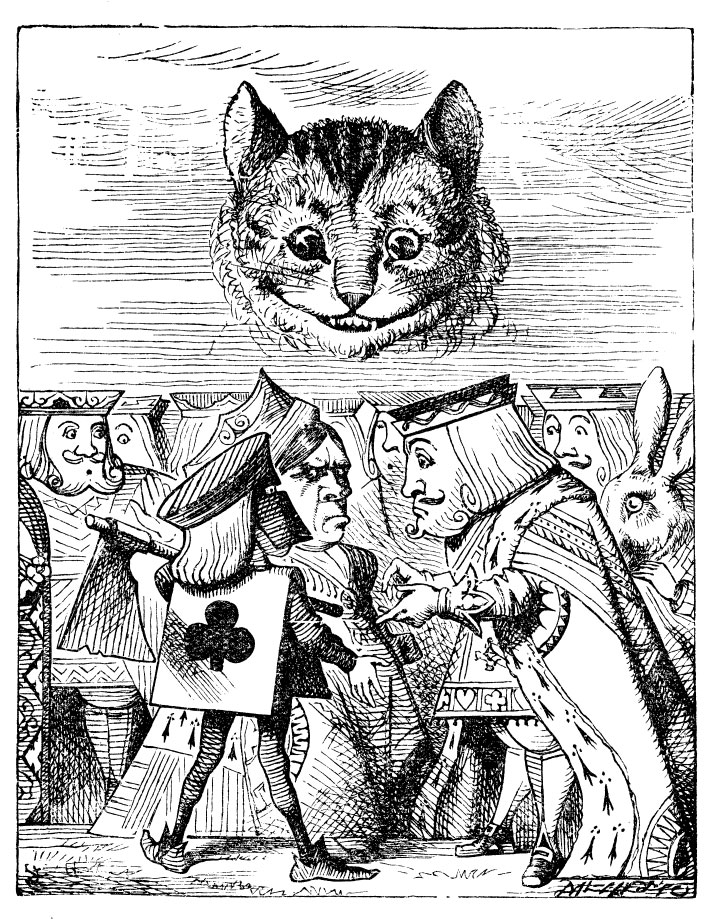
“It’s a friend of mine–a Cheshire Cat,” said Alice: “allow me to introduce it.”
“I don’t like the look of it at all,” said the King: however, it may kiss my hand, if it likes.”
“I’d rather not,” the Cat remarked.”
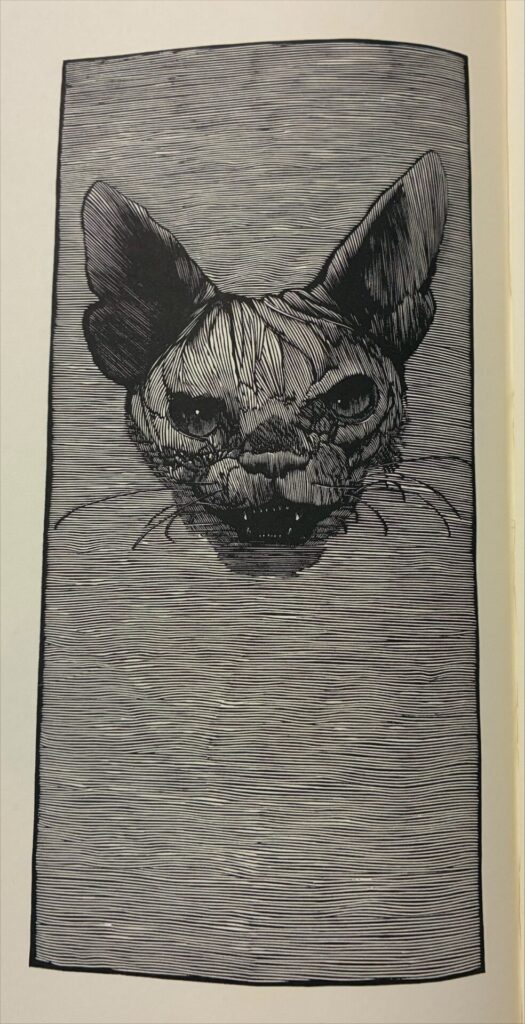
Alice’s relationship to cats is the strongest relationship in the book. The Cheshire Cat is the only Wonderland person/creature that she refers to as her friend, resulting from his guidance on her journey. He is also the only Wonderland inhabitant that has helped and been kind to her without any strings attached. Tenniel’s drawing of the Cheshire Cat depicts him as fluffy and inviting. As opposed to Moser’s, which shows him as fur-less and slim.
Alice and Cats
Even though Alice’s pet cat Dinah isn’t present during Alice’s Adventure’s through Wonderland, she plays a big role in inadvertently establishing Alice’s position in the social hierarchy and raising it. Alice utilizes many animal citizen’s fear of cats to gain respect, by threatening to sic Dinah on them.
Many scholars theorize that Alice connects with the Cheshire Cat because he is Dinah’s dream-self/guardian/familiar. This resonates with Wonderland’s pattern of things being the opposite of Alice’s world. Dinah is demure outside of the rabbit hole, but now she is a mischievous and mysterious creature. This theory hinges on the concept that Dinah has transferred her body or consciousness to become the Cheshire cat, through becoming one with her surroundings. One of the other ways he is connected are his disappearances. They make him absent from the scene, but his presence is always there because of his adaptability to his habitat.
Alice as an Anomaly
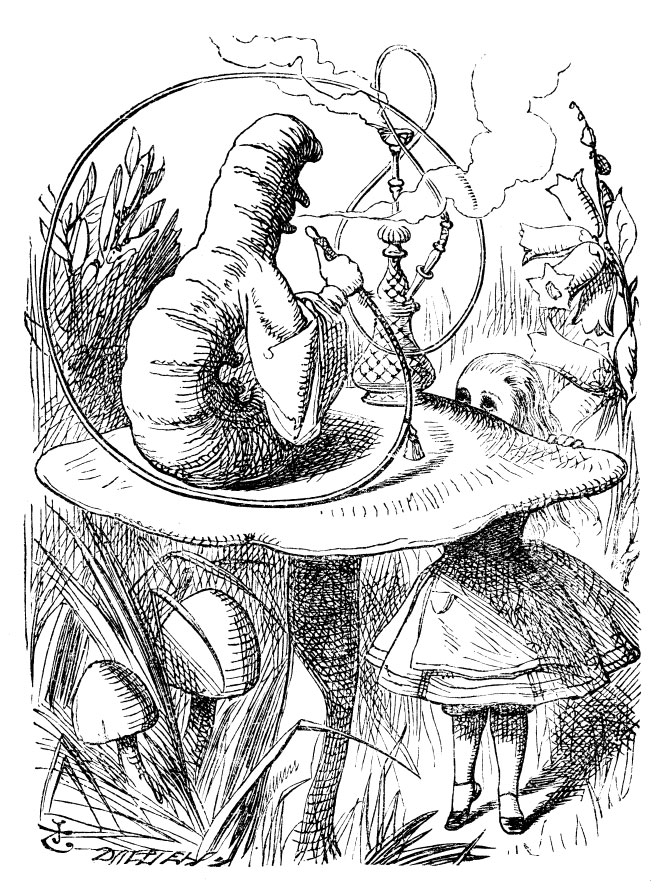
“Who are you?” said the Caterpillar.
This was not an encouraging opening for a conversation. Alice replied, rather shyly, “I–I hardly know, Sir, just at present–at least I know who I was when I got up this morning, but I think I must have been changed several times since then.”
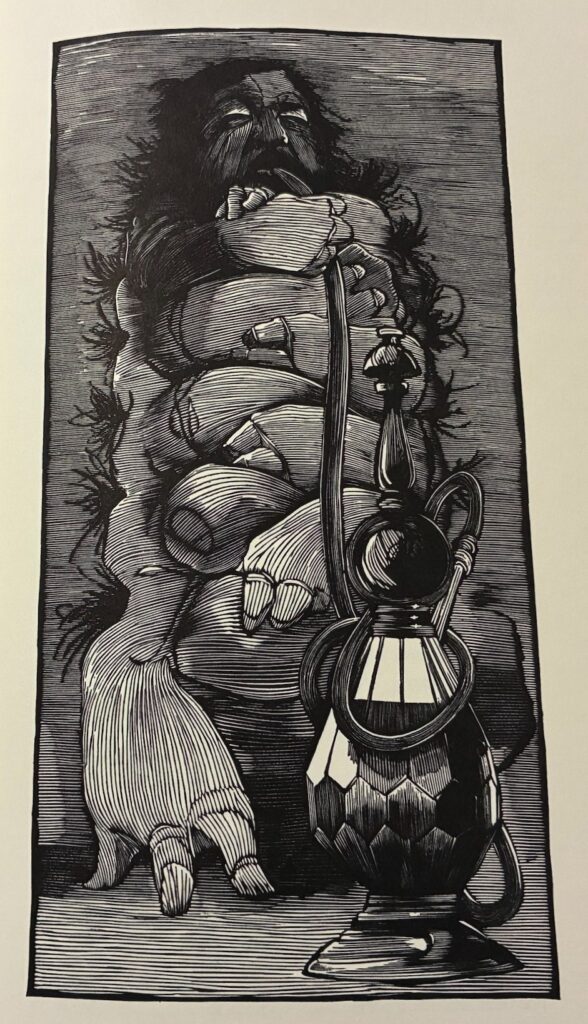
Alice is an foreign force that upsets the natural balance of Wonderland because, due to her being raised outside of Wonderland, she has contrasting morals and values. This causes the Wonderland denizens to try to define her within the rules of Wonderland’s environmental world-building, but no matter how hard they try they cannot seem to understand her. The Caterpillar is one of those animals, he questions her about what her identity is and her opinion of herself to gauge her. Tenniel’s Caterpillar is hunched and relaxed. He is very inquisitive, but does not come across like he is interrogating her. On the other hand, Moser’s Caterpillar stands up straight with his arms crossed. His line of questioning is stern and aggressive.
Alice as an Anomaly
Through the use of taxonomy, the animals repeatedly and mistakenly define Alice as a serpent, a wilting flower, a dream figment, and a monster. She is an unknown variable which causes the Caterpillar to be quick to anger. It causes him more distress when Alice’s answers to his questions provide no clarity and yield new questions. As a result of their inability to be able to define her, she is perceived as a threat to the familiarity of their ecosystem.