Effect on Alice
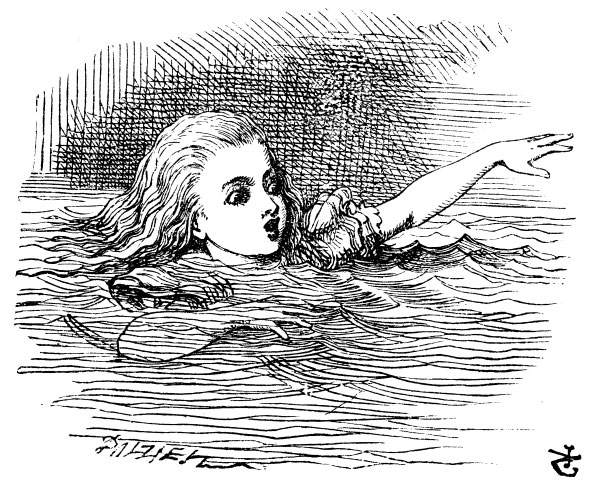
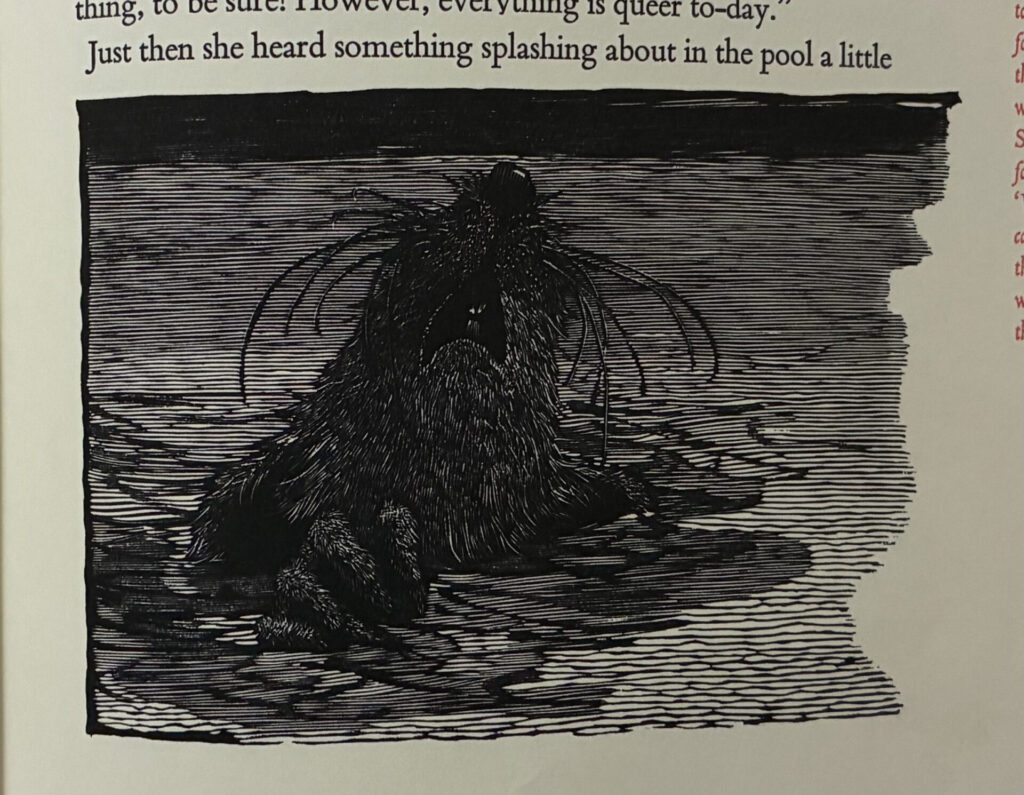
“I wish I hadn’t cried so much!” said Alice, as she swam about, trying to find her way out. “I shall be punished for it now, I suppose, by being drowned in my own tears! That will be a queer thing, to be sure! However, everything is queer to-day.”
Food and drink heavily influence Alice’s perception of her environment in Alice’s Adventure’s In Wonderland, by changing her size. Alice must adapt to edible things being as much a part of the environment as the environment itself. In the quote, Alice must deal with the repercussions of crying so excessively that she ends up creating a sizeable body of water and getting trapped in it after drinking a shrinking drink. Alice’s tears wouldn’t have been an obstacle for Alice when she was bigger, but for smaller Alice it feels like a herculean task. Tenniel and Moser’s illustrations offer a close-up of someone in the pool of tears. In Tenniel’s illustration, he depicts Alice struggling to stay afloat. She has a look of shock on her face because she finds it difficult to wrap her head around how a simple act like crying caused her current predicament. Moser’s illustration captures a rodent becoming trapped in the water and having to deal with the effects of Alice’s actions. The animal is sobbing because it’s scared and unsure what the best course of action would be.
Effect on Alice
Alice’s perception of her environment influences the reader’s perception of it as well. The reader changes how they approach reading the story along with the shifts in her growth to better understand what Alice is going through at the point in the story. This means that because Alice changes size many times, the reader is continually gaining new vantage points of and perspectives on Wonderland.
Perception of Alice
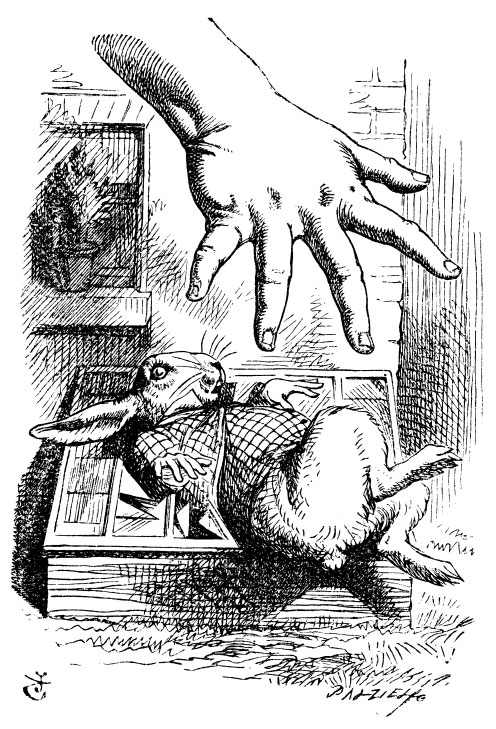
“That you wo’n’t!” thought Alice, and,* after waiting till she fancied she heard the Rabbit just under the window, she suddenly spread out her hand, and made a snatch in the air. She did not get hold of anything, but she heard a little shriek and a fall, and a crash of broken glass, that she concluded it was just possible it had fallen into a cucumber-frame, or something of the sort.”
Her size also gives her more or less power, it influences how much confidence she has when finding her way through Wonderland. When she’s small, the caterpillar is domineering. When she’s big, many Wonderland animals are frightened of her. Her constant differentiating sizes shifts the social hierarchy. Her actions in the text, show how she chooses to interact with others when she is large. Tenniel and Moser’s interpretations of the scene are incredibly unalike. Tenniel shows the moment where she reaches out her hand and the White Rabbit’s frightened reaction to it. Moser shows her moment of contemplation before drinking the enlarging drink, which starts a domino effect leading to her sticking her hand out of the window.

Perception of Alice
Similar to the Alice as an Anomaly section, because Alice’s growth spurts are so drastic and frequent, the animals are not sure where she fits within Wonderland’s society. Each new growth spurt raises new questions about how the animals should approach interactions with her. The animals also seem to be extremely surprised by her growth. The size shifting edibles seem commonplace, but only the Caterpillar acknowledges the matter.
Wondrous Wordplay
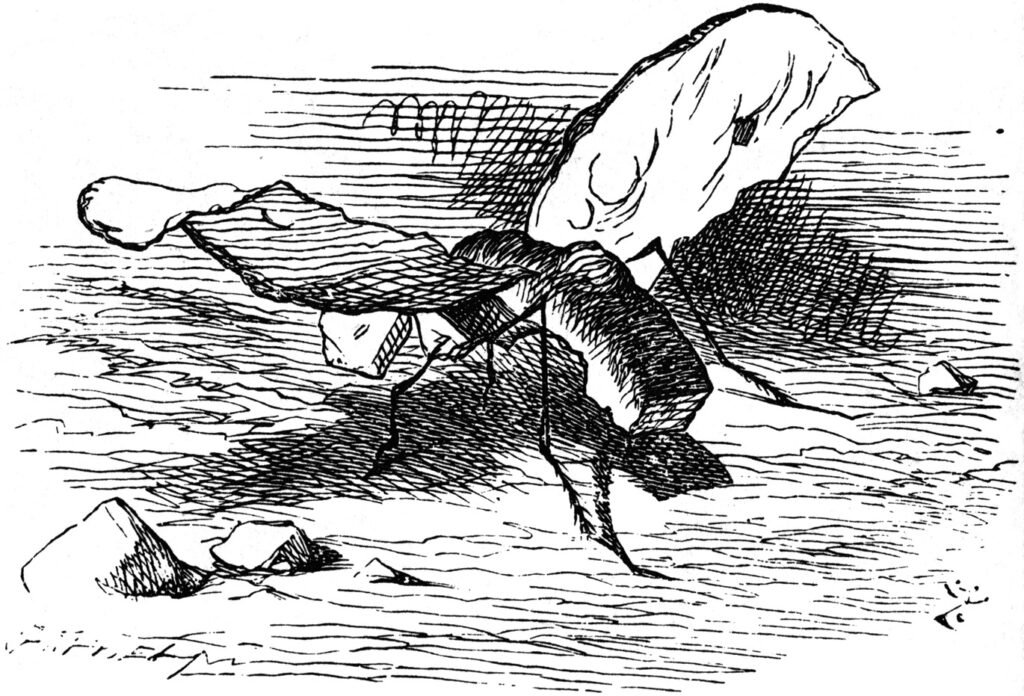
“Crawling at your feet,” said the Gnat (Alice drew her feet back in some alarm), “You may observe the Bread-and-butter-fly. It’s wings are thin slices of bread-and-butter, its body is a crust, and its head is a lump of sugar.”
“And what does it live on?”
“Weak tea with cream in it.”
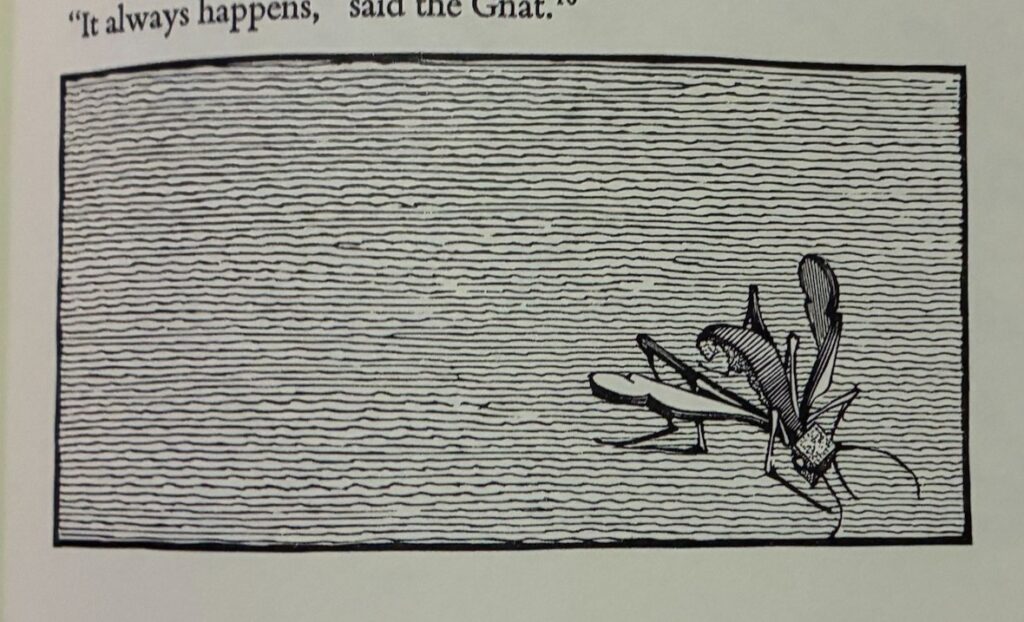
Unlike other instances, where food influences the perception and access to the environment, Carroll blends animal and object to subvert Alice and readers expectations of what they believe the setting will be by taking real names of creatures literally. An example of this is the-bread-and-butterfly. The Gnat’s description of the insect conveys how the qualities of each piece of food that make up the body are useful for survival. In Tennial’s picture of the bug, one is able to see the specific parts of the body and the insect takes up the whole frame. It provides more insight into the surrounding environment that it inhabits as well. In Moser’s drawing, the texture of each piece of food is significantly different and detailed. The-bread-and-butterfly is in the corner of the drawing and the rest is empty space. Moser gives the reader a better understanding of the size of it by playing with perspective. But unlike Tenniel’s, the landscape is ambiguous.
Wondrous Wordplay
Carroll wordplay bugs are used to commentate on extinction and non-adaption. The-bread-and-butterfly is unable to eat anything except weak tea because of it’s inability to adapt, leading to constant deaths. This leaves the insect with only one option, to sit and reflect. Carroll drew inspiration for this situation from the Malthusian nightmare, a theory articulated by Thomas Robert Malthus in 1798. The Malthusian nightmare is defined as resources being linear for a consistent period of time, which reduces living standards and leads to population decline.
Creating Obstacles
“Soon her eye fell on a little glass box that was lying under the table: she opened it, and found in it a very small cake, on which the words”EAT ME” were beautifully marked in currants. “Well, I’ll eat it,” said Alice, “and of it makes me grow larger, I can reach the key; and if it makes me grow smaller, I can creep under the door: either way I’ll get into the garden, I don’t care what happens!”
*Pennyroyal edition doesn’t have a comma between and and after.
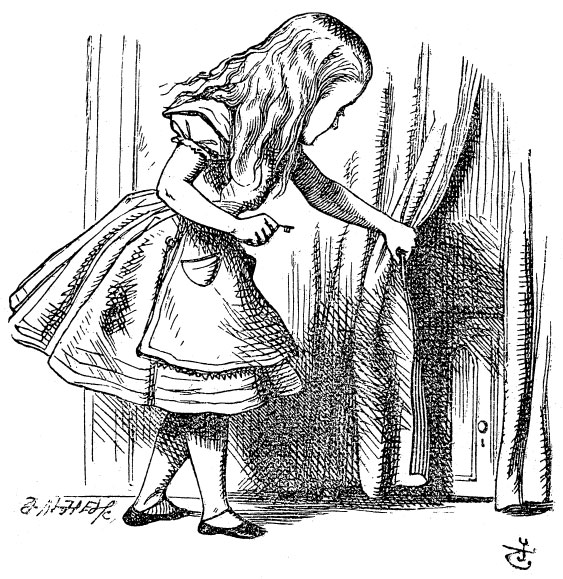
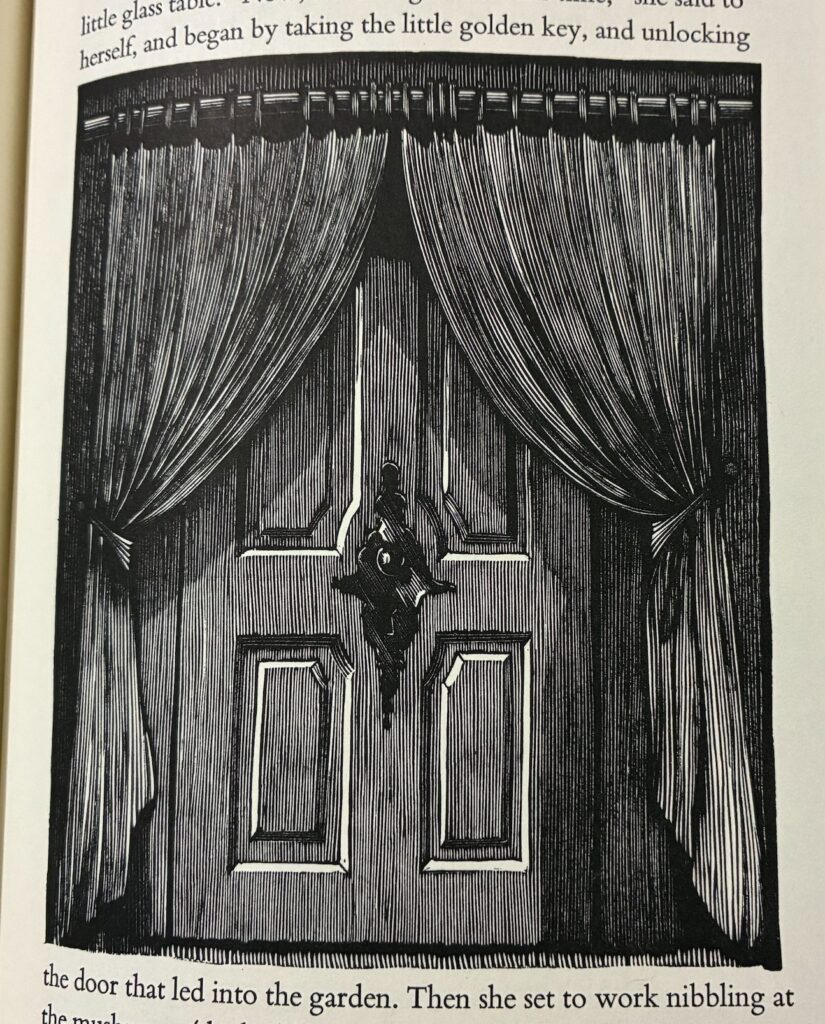
Alice manipulates her size through food and drink in Alice’s Adventure’s In Wonderland, to enter and exit the various sections of the environment in order to reach the Queen’s garden. After trial and error, through her internal monologue’s, Alice starts consistently planning out how she’ll adapt to her environment in every potential growth scenario. The focal point of Tenniel’s illustration of one of her monologues is a very large Alice staring at the tiny door. She’s actively contemplating how she’ll fit through it. Moser’s drawing only focuses on the details of the door.
Creating Obstacles
Not only do the growth edibles create physical obstacles, they force Alice to think critically. In order for Alice to learn how to strategically utilize the foods and drinks to make her way through the environment, she must learn resource management. She must figure out plans for when she eventually runs out of her growth edibles and think of ideas for where she could potentially find more. She also needs to create a plan for what she might do if she’s stuck without any more while she’s small or large. Alice’s resourcefulness gives her the ability to reach her end goal, instead of getting stuck in one area of Wonderland due to a lack of caution.